Patent Pending: US 63/741,861

HomFax Forensic Hub

Developer Specification & Visual Architecture

The complete developer-grade blueprint for the Ambassador platform's forensic single-source-of-truth. Tamper-evident property history, cryptographic proofs, AI-powered damage analysis, and smart-contract integration.

Introduction

High-Level Summary

HomFax is the Ambassador platform's forensic single-source-of-truth. It is a tamper-evident property-history and forensic-documentation subsystem that ingests and corroborates multi-source evidence, records cryptographic hashes on a distributed ledger, and issues verifiable HomFax reports that trigger smart-contract actions. Built for audit, dispute resolution, and automated settlement, HomFax converts photos, sensor feeds, municipal records, and expert entries into hash-verified evidence and fraud alerts, ensuring every milestone payment and warranty claim is driven by provable, immutable proof.

Core Responsibilities

Ingest and normalize evidence from various sources, including binary files and structured metadata.

Compute cryptographic hashes and batch proof structures, anchoring proofs to a distributed ledger.

Run AI-powered forensic analysis to classify damage, determine severity, and differentiate pre-existing from new damage.

Store large files off-chain with immutable references (S3/IPFS) and provide fast CDN access.

Produce Verifiable HomFax Reports and Fraud Alerts for portals, insurers, and smart contracts.

Provide secure APIs, event webhooks, and an admin UI for QA, forensic review, and integration.

System Architecture

Verified

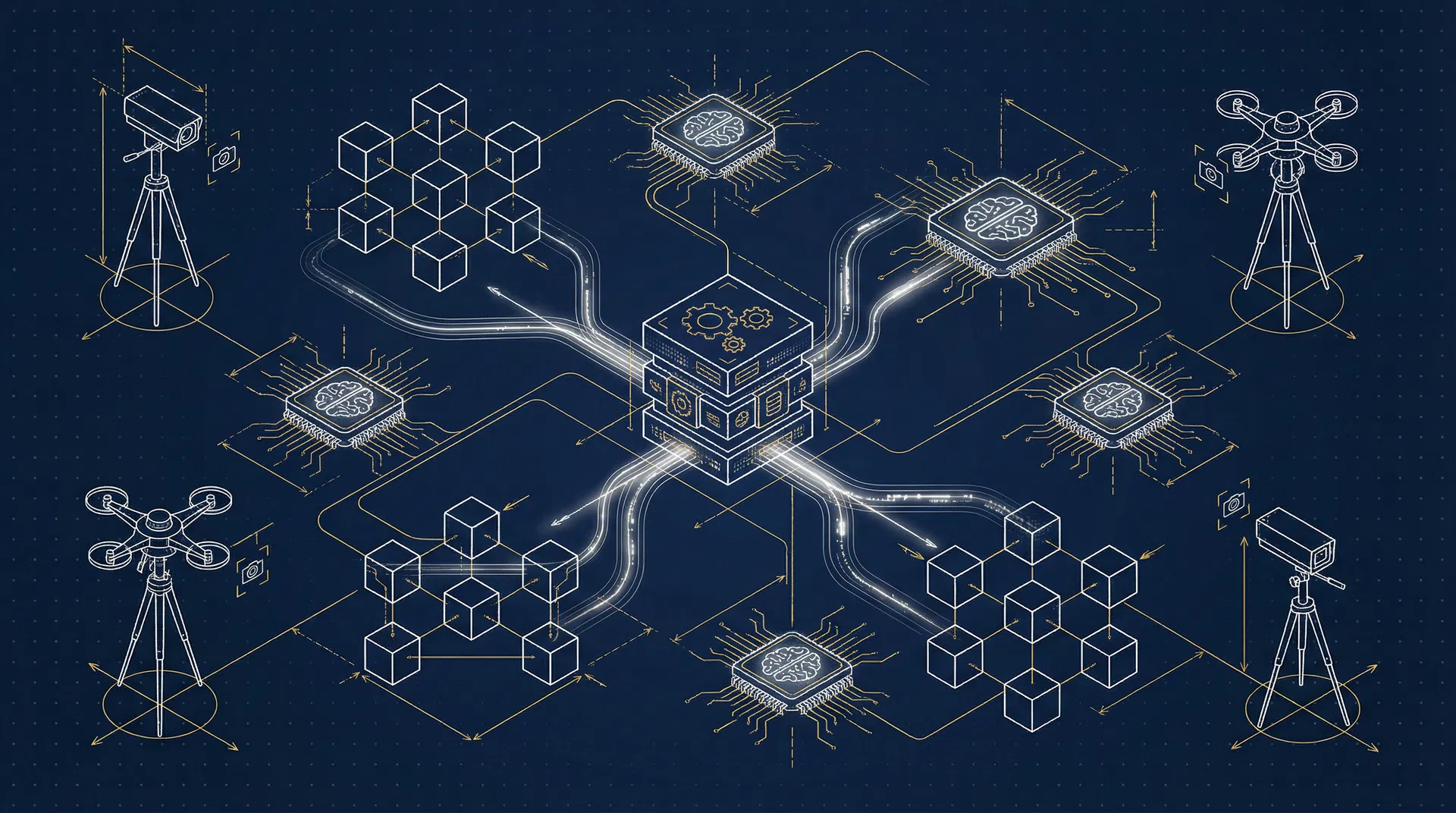
The overall system architecture is designed for scalability, security, and verifiability. It separates concerns into distinct layers, from evidence input to on-chain anchoring and final consumption by various stakeholders.

HomFax System Architecture
Click to enlarge
Figure 1: A high-level overview of the HomFax Forensic Hub's architecture, showing the flow from evidence inputs to consumer portals and smart contract execution.

Architectural Components

LayerComponentDescription
InputsEvidence SourcesInspector uploads, IoT/weather feeds, municipal records, and manual expert entries.
IngestionData Ingestion LayerSecure API endpoints (REST/GraphQL) with JWT/mTLS auth and Kafka/RabbitMQ queuing.
StorageOff-Chain StorageEncrypted, versioned object storage (AWS S3/IPFS) with CloudFront CDN.
AI PipelineForensic AI PipelineMulti-stage pipeline: preprocessing, feature extraction, damage classification, severity scoring.
HashingHashing & Proof EngineSHA-256 hashing, Merkle trees for batching, and ECDSA digital signatures.
LedgerHomFax LedgerAppend-only MongoDB database for property history, evidence records, and audit trails.
BlockchainBlockchain AnchorSmart contract bridge anchoring Merkle roots to Polygon for public verifiability.
OutputsHomFax OutputsVerifiable reports, fraud alerts, smart contract triggers, and audit trail records.
ConsumersConsumer PortalsRole-based web portals for Homeowners, Contractors, Insurers, Attorneys, Inspectors.
ExecutionSmart Contract EngineDeploys contracts, releases milestone payments, manages dispute resolution.

Evidence Lifecycle & Data Flow

Verified

The lifecycle of a piece of evidence is a critical workflow that ensures integrity and verifiability at every step. The process is designed to be automated, secure, and auditable.

Evidence Lifecycle Data Flow
Click to enlarge
Figure 2: The end-to-end data flow for a piece of evidence, from initial upload through AI analysis, on-chain anchoring, and final smart contract action.

Lifecycle Stages

1

Upload & Ingest

Evidence is submitted via a secure API, authenticated, and streamed to S3, while metadata is extracted.

2

Hash & Sign

A SHA-256 hash is computed for the file. A canonical JSON record is created, hashed (record_hash), and signed by the inspector.

3

AI Forensic Analysis

The evidence undergoes a detailed AI pipeline analysis, with the results appended to the record.

4

Fraud Detection

The record is checked against a rules engine and ML models. Anomalies trigger alerts and may pause the workflow.

5

On-Chain Anchoring

The record_hash is batched into a Merkle tree, and the merkle_root is anchored to the Polygon blockchain.

6

Report Generation

A verifiable HomFax Report is generated, hashed, and stored. A webhook notifies subscribed systems.

7

Smart Contract Actions

The Smart Contract Execution Engine receives the verified event and triggers the appropriate on-chain action.

Upload → Hash → Anchor (Pseudocode)

evidence_upload.pypython
# 1. Upload files to S3 (presigned)
upload_files_to_s3(files)

# 2. For each file compute SHA-256
for f in files:
    f.file_hash = sha256(f.stream)

# 3. Build evidence JSON (canonical)
record = canonicalize({
    property_id: pid,
    claim_id: cid,
    files: files_meta,
    metadata: meta
})
record_hash = sha256(json_canonical(record))

# 4. Store 'pending' record in DB
db.insert('evidence_records', {
    ..., record_hash: record_hash,
    status: 'pending'
})

# 5. Queue AI job
# After AI completes: update record.ai_analysis

# 6. When ready to anchor:
#    Build Merkle root, call anchor contract
tx = homfax_anchor_contract.anchor(
    propertyId, claimId,
    merkleRoot, metadataCid
)
await tx.wait()

# 7. Update DB with onchain_anchor
#    { tx_hash, block }

Data Model & Schemas

Verified

The data is modeled using a document-oriented approach (MongoDB) to accommodate the flexible, nested structure of forensic records. Key collections are indexed for performance on common query patterns such as property_id, timestamps, claim_id, and verification_status.

HomFax Data Model ERD
Click to enlarge
Figure 3: An Entity-Relationship Diagram showing the primary data collections and their relationships within the HomFax Ledger.

properties Collection

properties.jsonjson
{
  "_id": "property_0001",
  "address": {
    "street": "312 English Oak St",
    "city": "Georgetown",
    "state": "TX",
    "zip": "78626"
  },
  "parcel_id": "R012345",
  "owner": {
    "name": "Jane Doe",
    "contact": "[email protected]",
    "user_id": "usr_001"
  },
  "homfax_summary": {
    "last_report_id": "report_123",
    "fraud_score": 0.02
  },
  "created_at": "2026-02-07T12:00:00Z",
  "updated_at": "2026-02-07T12:00:00Z"
}

evidence_records Collection

evidence_records.jsonjson
{
  "_id": "evid_0001",
  "property_id": "property_0001",
  "claim_id": "claim_123",
  "uploader": {
    "id": "user_45",
    "role": "inspector",
    "signature_pubkey": "0x04a1b2c3..."
  },
  "source": "inspection",
  "files": [{
    "filename": "roof_damage_01.jpg",
    "content_type": "image/jpeg",
    "size": 345678,
    "storage_uri": "s3://homfax/props/xxx/img1.jpg",
    "file_hash": "sha256:a1b2c3d4e5f6..."
  }],
  "ai_analysis": {
    "damage_type": "wind",
    "severity": "moderate",
    "confidence": 0.93,
    "preexisting": false,
    "explanations": {
      "bbox": [120, 80, 340, 260],
      "saliency_map_uri": "s3://homfax/..."
    }
  },
  "metadata_hash": "sha256:meta1234...",
  "record_hash": "sha256:record5678...",
  "onchain_anchor": {
    "tx_hash": "0xabc123...",
    "chain": "polygon",
    "block": 123456
  },
  "verification": {
    "verified": true,
    "verified_at": "2026-02-07T13:00:00Z",
    "verified_by": "system"
  },
  "status": "verified",
  "audit": [{
    "event": "upload",
    "by": "user_45",
    "at": "2026-02-07T12:30:00Z"
  }]
}

homfax_reports Collection

homfax_reports.jsonjson
{
  "_id": "report_123",
  "property_id": "property_0001",
  "claim_id": "claim_123",
  "compiled_records": [
    "evid_0001",
    "evid_0002"
  ],
  "report_hash": "sha256:repab12...",
  "report_uri": "s3://homfax/reports/report_123.pdf",
  "fraud_alerts": [],
  "signatures": [{
    "role": "inspector",
    "signature": "0x3045...",
    "pubkey": "0x04a1b2c3..."
  }],
  "created_at": "2026-02-07T14:00:00Z"
}

Cryptographic Anchoring & Verification

Verified
Cryptographic verification visualization

Merkle tree batching and blockchain anchoring for tamper-evident proof

The cryptographic engine is the core of HomFax's tamper-evident guarantee. It combines hashing, digital signatures, and blockchain anchoring to create a verifiable chain of custody.

Cryptographic Anchoring Flow
Click to enlarge
Figure 4: The process of hashing evidence, batching it into a Merkle tree, anchoring the root on-chain, and the corresponding consumer verification flow.

Key Cryptographic Primitives

Hashing Algorithm: SHA-256 (hex) applied deterministically to canonical JSON blobs.
Canonicalization: JSON records use deterministic field ordering before hashing for consistent output.
Batch Anchoring: Merkle trees batch multiple record_hash values into a single merkle_root anchored on-chain.
Digital Signatures: ECDSA (secp256k1) for inspector signatures, providing non-repudiation.
On-Chain Verification: Smart contract method verifyRecord() validates record_hash against on-chain merkle_root.

Anchor Contract Call

anchor.jsjavascript
const tx = await homfaxAnchorContract.anchor(
    propertyId,
    claimId,
    merkleRoot,
    metadataCID,
    { gasLimit: 200000 }
);

const receipt = await tx.wait();
console.log("Anchored at block:", receipt.blockNumber);
console.log("TX hash:", receipt.transactionHash);

Verify Proof (Consumer)

verify.jsjavascript
// Given a report with record_hash,
// merkleProof, and anchorRoot:

const isMember = merkle.verify(
    merkleProof,
    recordHash,
    root
);

const onchainRoot = getRootFromChain(txHash);

return isMember && (onchainRoot === root);
// => true = tamper-proof verified

Forensic AI Pipeline

Verified
AI forensic pipeline visualization

The AI pipeline automates the analysis of visual evidence, providing objective, consistent, and scalable damage assessments. It processes images through multiple specialized neural network heads for comprehensive forensic analysis.

Forensic AI Pipeline
Click to enlarge
Figure 5: The detailed stages of the AI forensic pipeline, from raw input processing to the final analysis output.

Pipeline Stages

1. Preprocessing

Normalizes images, corrects orientation via EXIF, and merges multi-modal data (thermal + visible light). Temporal pairing for before/after comparison.

2. Feature Extraction

A CNN backbone (ResNet, ConvNeXt, or EfficientNet) extracts high-dimensional feature embeddings from preprocessed images.

3. Task Heads

Multiple specialized heads: Damage Classification (multi-label: wind, hail, water, fire, impact), Severity Regression (0.0–1.0), Pre-existing Classifier, and Instance Segmentation (Mask R-CNN / SAM).

4. Ensemble & Calibration

Combines vision outputs with metadata (timestamp, weather event proximity, GPS) and applies temperature scaling for calibrated confidence scores.

5. Explainability

Generates Grad-CAM saliency heatmaps, bounding box annotations, and natural language explanations for each decision. Artifacts stored to off-chain storage.

API Specification

The HomFax hub exposes a set of secure REST/GraphQL endpoints for interaction. All endpoints require authentication (JWT) and may require mTLS for corporate partners.

Endpoints

MethodEndpointAuthDescription
POST/v1/homfax/inspectionsJWT + mTLSUpload an inspection package (files + metadata). Triggers the entire evidence lifecycle.
GET/v1/homfax/records/{id}JWTFetch the full JSON for a specific evidence record.
POST/v1/homfax/verifyJWT (Inspector/Insurer)Request verification or re-verification of a record or report.
GET/v1/homfax/reports/{id}JWTDownload a verifiable HomFax Report (signed JSON + PDF URI + anchors).
GET/v1/homfax/property/{id}/historyJWTRetrieve the paginated forensic history for a given property.
POST/v1/homfax/webhook/registerJWT (Admin)Register a webhook to subscribe to HomFax events.

Webhook Events

HomFaxReportGenerated

A new verifiable report has been compiled and anchored.

FraudAlertRaised

An anomaly was detected during evidence analysis.

OnchainAnchorCommitted

A Merkle root has been successfully anchored on-chain.

VerificationFailed

A record or report failed integrity verification.

RecordUploaded

New evidence has been uploaded and is pending processing.

AIAnalysisComplete

AI forensic analysis has finished for a record.

Webhook Payload Example

webhook_payload.jsonjson
{
  "event": "HomFaxReportGenerated",
  "report_id": "report_123",
  "property_id": "property_0001",
  "claim_id": "claim_123",
  "report_hash": "sha256:repab12...",
  "onchain_anchor": {
    "tx_hash": "0xabc123...",
    "block": 12345
  }
}

Security & Access Control

Verified

Security is paramount. The system employs a multi-layered security model to protect data integrity, confidentiality, and availability. All communications must use HTTPS/TLS 1.3, and all data at rest is encrypted with AES-256.

Security & Access Control Model
Click to enlarge
Figure 6: An overview of the security model, covering identity, access control, encryption, tamper protection, and auditing.

Security Layers

Authentication

OAuth2/JWT for users, mTLS for system-to-system communication.

Authorization

Strict RBAC: Admin, Inspector, Contractor, Insurer, Auditor, System.

Encryption

AES-256 at rest (SSE-KMS), TLS 1.3 in transit, certificate management.

Key Management

AWS KMS or HashiCorp Vault with strict access policies and rotation.

Tamper Protection

Append-only writes, cryptographic hashing, digital signatures, blockchain anchors.

Auditing

Structured JSON logs, distributed tracing (OpenTelemetry), comprehensive access logging.

RBAC Role Matrix

RolePermissions
AdminFull system access, key rotation, user management
InspectorUpload, sign, verify own records
ContractorView assigned claims, submit milestones
InsurerRead reports, verify, dispute management
AuditorRead-only audit trail, chain-of-custody
SystemAutomated services: anchor, AI, report generation

Deployment & Infrastructure

The platform is designed for a cloud-native deployment on AWS, leveraging a containerized architecture managed by Kubernetes (EKS) for scalability and resilience.

Deployment Architecture
Click to enlarge
Figure 7: The recommended deployment architecture on AWS, illustrating the flow from clients through the EKS cluster to backend data and security services.

Recommended Technology Stack

CategoryTechnology
Cloud ProviderAWS (S3, EKS, CloudFront, KMS)
Container OrchestrationAmazon EKS (Kubernetes)
Message QueueApache Kafka or RabbitMQ
DatabaseMongoDB Atlas (Replica Set)
Object StorageAWS S3 with Object Lock (WORM)
CDNAWS CloudFront
SecurityAWS WAF, KMS, HashiCorp Vault
BlockchainPolygon (Mainnet + Mumbai testnet)
ObservabilityOpenTelemetry, CloudWatch, Grafana
AI InferenceGPU nodes (gRPC/REST endpoints)

90-Day Development Roadmap

The following Gantt chart outlines a proposed 90-day development plan to deliver the Minimum Viable Product (MVP) of the HomFax Forensic Hub.

90-Day Development Roadmap
Click to enlarge
Figure 8: A 90-day Gantt chart detailing the development milestones, from foundational work to integration and hardening.

Phase Summary

Wk 1–2

Foundation

Core Ingestion API, S3 storage, canonicalizer, DB, and basic record hashing.

Wk 3–4

Crypto Engine

Hashing engine, Merkle root batcher, anchor service (Hardhat), ECDSA module.

Wk 5–7

AI Pipeline

Image preprocessing, CNN model training, severity scoring, pre-existing detection, GPU inference.

Wk 8–10

Reports & Fraud

Verifiable report generator, webhook system, fraud rules engine, ML anomaly model.

Wk 11–13

Integration

Smart contract bridge (testnet), admin UI/QA dashboard, end-to-end tests.

Wk 14+

Hardening

Security pen testing, scalability testing, compliance review, production rollout.

References & Resources

Ambassador Patent

"A System and Method for Blockchain-Based Property Claim Lifecycle Management..." (U.S. Non-provisional Patent Application, Patent Pending: US 63/741,861)

Ambassador Smart Contract System Agreement

Defines the HomFax Ledger, Verifiable HomFax Reports, and the claim workflow.

Ambassador QualityChain Deployment Guides

Provides scripts and configurations for smart contract deployment and anchor patterns.

Related Links

Contact: [email protected] | (800) 701-7663

Owner: Regulus Development Corporation (RDC LLC) | Version 1.0 | February 2026